
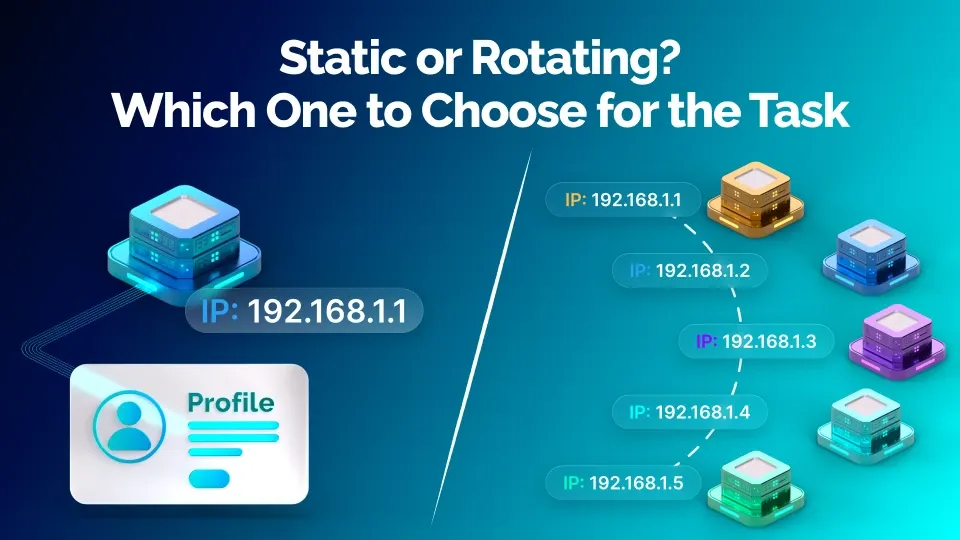
Choosing a proxy often begins with location (geo), speed, and price, but an equally important point to consider is how long a single connection address persists. Some tasks require a fixed connection, while others demand regular IP address rotation and distribution across a large pool.
This is why, before purchasing, it is important to understand the difference between static and rotating proxies. They address different needs, and there is no universal option: the choice depends on your workflow, session duration, and request volume.
How Static Proxies Work
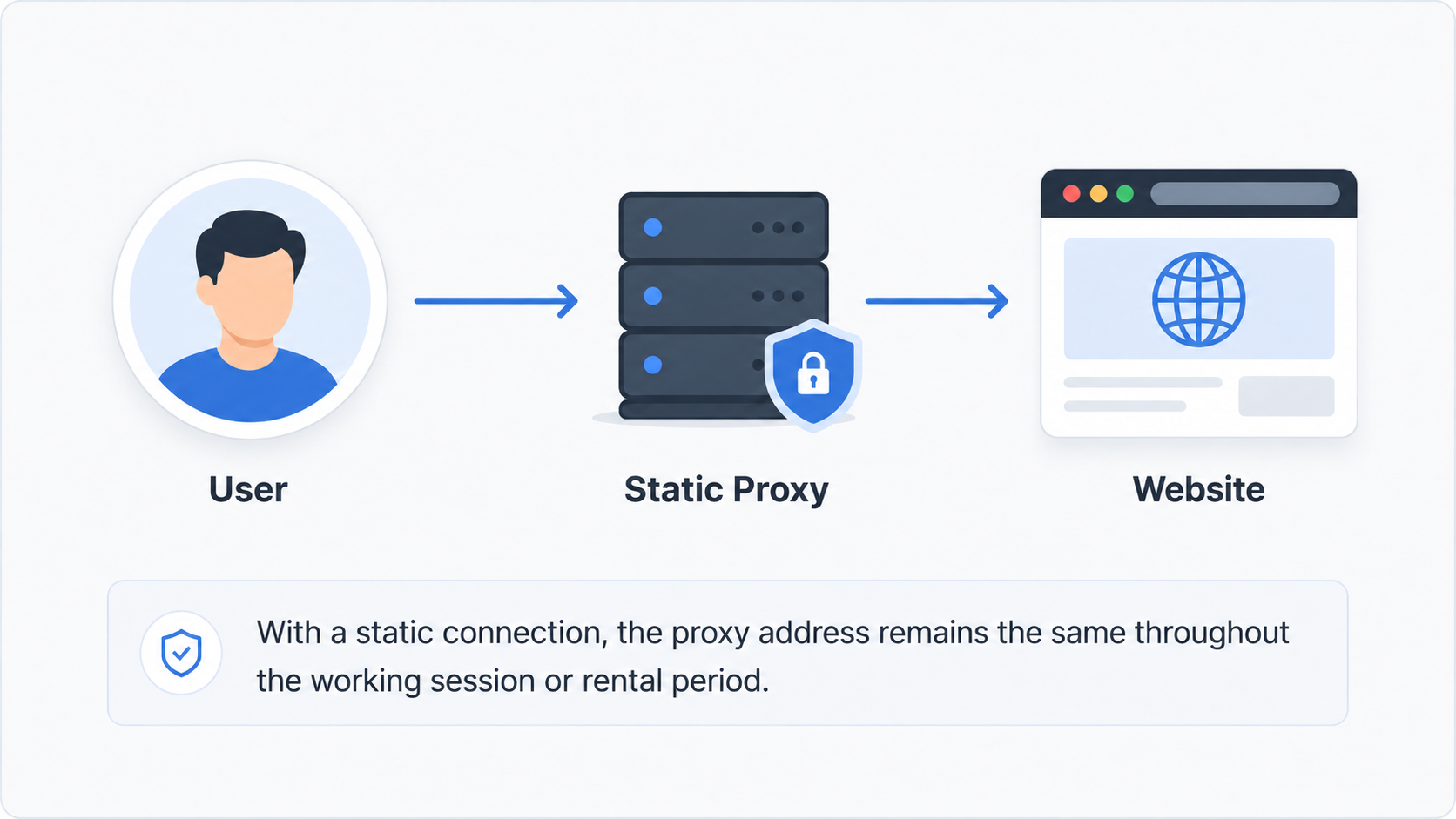
A static proxy provides an IP address that remains unchanged throughout the entire subscription period or an extended session.
The user connects to the server using the same credentials, and the destination resource sees the exact same network connection on subsequent requests.
This option is well-suited for scenarios where a consistent environment is necessary. For instance, if a dedicated browser profile is used regularly to interact with a single service, frequent connection changes are unnecessary.
Static proxies are also easier to organize for a team: a specific proxy can be assigned to a particular profile, project, or workflow without alteration.
When working with an antidetect browser, this setup is particularly instinctive: unique connection parameters are preconfigured for each profile, and the proxy remains attached to the entirety of the session.
What Are Rotating Proxies
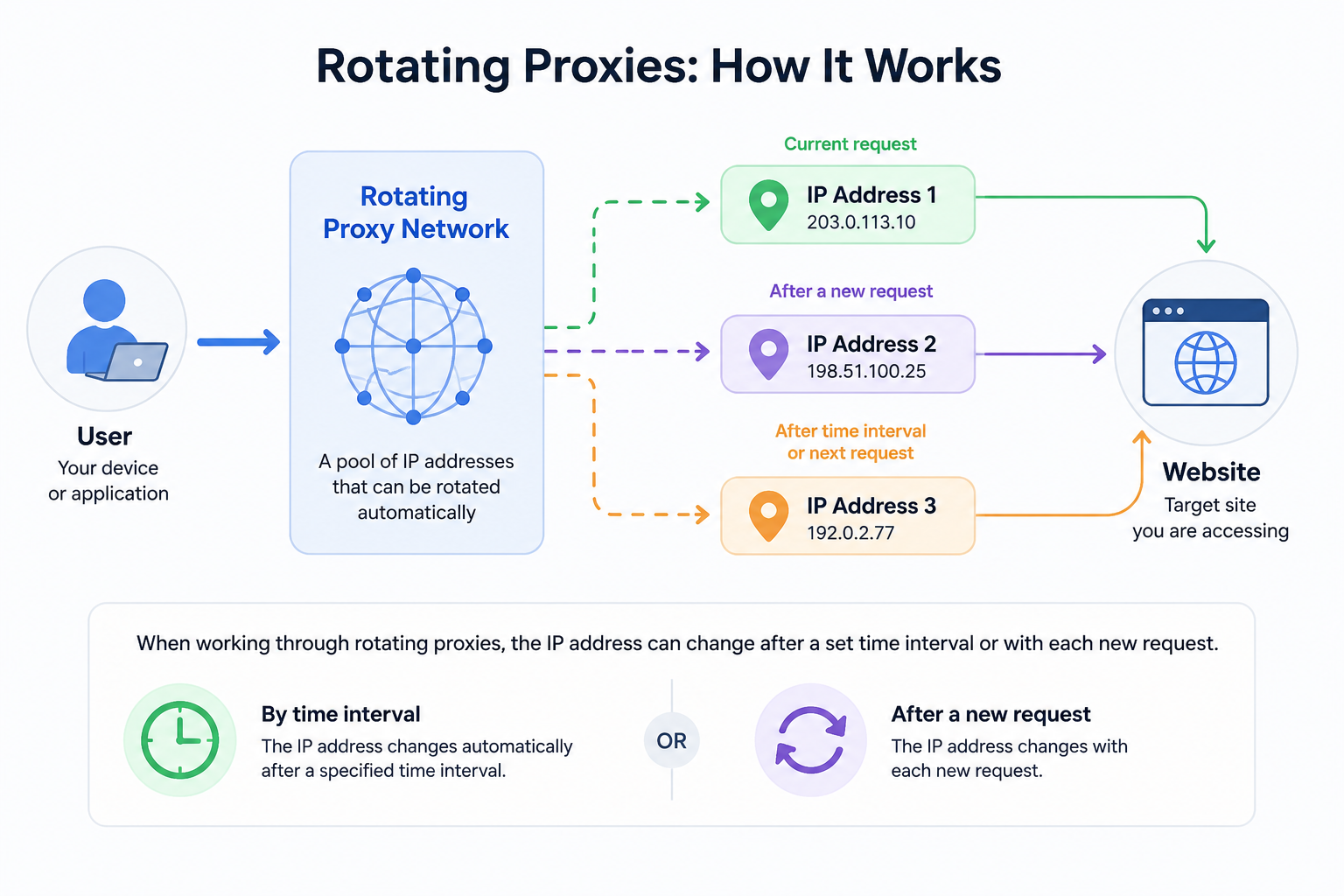
Rotating proxies operate differently. Instead of a single address, the user gains access to an IP pool between which the service rotates regularly.
Rotation can occur during different scenarios: after a new request or login, after session termination, or at designated time intervals.
For example, a user can set a specific session duration and work with a single IP address. Once that period expires, the connection automatically switches to another address from the available pool.
This approach is especially useful for tasks involving large volumes of repetitive requests while maintaining a constant connection is not required.
The Key Difference Goes Beyond Just Changing IPs
At first glance, the distinction seems straightforward: a static proxy remains constant, while a rotating proxy changes regularly.
In practice, what matters more is the session type required for the specific task.
If the workflow involves long-term interaction with a single resource, authorization, and returning to the exact same environment, a fixed connection is usually more practical.
If the task consists of numerous independent requests, retaining a single address doesn’t offer much advantage. In this case, rotation provides more flexible load distribution.
Therefore, you should not choose a proxy type purely based on assumptions like "static is more reliable" or "rotating is more versatile." Both options are effective within their own right and respective scenarios.
When to Use Static Proxies
One of the most obvious cases is managing separate browser profiles.
If a specialist creates multiple working environments in Aurorium for different projects, each can be assigned a dedicated static proxy. This simplifies organized infrastructure and makes it clear which profile uses which connection.
Static proxies are also well-suited for:
- Long-term authenticated sessions;
- Working with corporate and enterprise services;
- Remote access to internal work tools;
- Testing websites from a specific country;
- QA and verification of localized product versions;
- Tasks that require regularly returning to the same working environment.
At the same time, it is important to evaluate more than just the nature of the IP. Factors such as address origin, available locations, network quality, connection speed, and supported protocols all play an equally major role.
For instance, static proxies can be datacenter-based or ISP-assigned. Outwardly, the operating principle is similar, but network characteristics and pricing can differ significantly.
When Rotating Proxies Are More Effective
Rotation is most frequently used when workloads consist of a large volume of individual requests.
A prime example is collecting open data (web scraping). When you need to regularly extract information from many web pages, monitor price changes, track search engine results pages (SERPs), or perform technical website audits, using a proxy pool allows you to distribute requests across multiple addresses.
Typical use cases include:
- Public data scraping;
- SEO monitoring;
- SERP tracking across different regions;
- Price and inventory monitoring;
- Automated testing;
- Analytics data collection;
- Content availability verification across different countries.
For such scenarios, pool size, available locations, and the ability to control session duration are especially important.
Continuous IP rotation on every single request is not always necessary. For example, if a target website requires several sequential actions within a single session, it makes more sense to maintain the connection for at least a few minutes before rotating.
How to Choose the Right Option
Before deciding, it helps to answer several key questions:
- Do you need to maintain a single session for an extended period?
If yes, a static proxy will generally be more convenient. If every request is independent of the previous one, rotating proxies should be considered. - How many requests do you plan to execute?
For a small set of persistent working profiles, dedicated static proxies are easier to manage. For high-volume automated requests, scaling through an IP pool is typically more practical. - How important is precise geo-targeting?
Country-level selection is enough for some tasks, while others require a specific region or city. Geo-targeting abilities vary depending on the proxy type and provider. - Does the address need to change automatically?
If the proxy needs to switch without manual intervention, choose a service that supports automated rotation with self-configured session duration. - How will the proxy be used inside the browser?
When working via Aurorium, proxies can be mapped to individual profiles. It is best to define the structure in advance: which profiles must consistently operate through a single connection and where rotation is acceptable and/or necessary.
Why Proxy Type Matters As Well
Static vs. rotating is only one parameter. The network type from which the traffic originates is equally important.
- Residential proxies use IP addresses assigned by internet service providers (ISPs) to real household users and are typically provided through a large rotating pool.
- ISP proxies are hosted within datacenter infrastructure, but their IP addresses are officially registered under consumer ISPs. They can be utilized in static formats as well as other configurations depending on the provider.
- Datacenter proxies operate directly out of data centers and are frequently chosen for tasks where speed and cost efficiency are the main priorities.
"Static" vs. "rotating" refers strictly to the proxy delivery mechanism. The underlying type—residential, ISP, or datacenter—determines the IP origin, network trust profile, and operational performance.
Two Practical Scenarios
Consider a specialist handling two tasks simultaneously:
- First task: Testing a localized version of a web service across multiple Aurorium profiles. Each profile is used regularly, and its environment must remain consistent across sessions.
The logical choice here is assigning a dedicated static proxy to each profile. - Second task: Checking thousands of web pages daily and logging data changes, where maintaining a single connection across all requests is unnecessary.
In this case, using rotating proxies with an appropriately configured session duration is much more effective.
A single project can easily employ both types at the same time.
What to Verify Before Getting Started
Regardless of the option you choose, check the following parameters before connecting:
- Does the proxy country match your target region?
- Is the connection detected correctly without anomalies?
- Are there any DNS leaks?
- Is the required protocol supported (HTTP, HTTPS, or SOCKS5)?
- Is the connection speed adequate for your task?
- Is the proxy assigned to the correct browser profile?
It is also good practice to ensure that the same proxy is not accidentally reused across multiple isolated environments when the infrastructure was originally designed to keep them segregated.
Choosing Proxies in Practice
For example, MangoProxy provides both static and rotating proxies—including residential, datacenter, and ISP proxies—depending on the specific task.
For high-volume request workflows, pay-as-you-go traffic plans with granular geo-targeting are well-suited, while persistent work environments benefit from static datacenter and ISP proxies. Support for HTTP, HTTPS, and SOCKS5 protocols ensures seamless integration with profiles in Aurorium.
Aurorium users can apply promo code AURORIUM for an 8% discount on static ISP proxies from MangoProxy.
When deciding on a solution, align with the specific technical requirements of your project rather than a blanketed outcome.
Summary
Static proxies are best suited for workflows that require a persistent connection and long session retention. Rotating proxies are more convenient for handling large volumes of independent requests, automation, monitoring, and web scraping.
In practice, these two approaches do not compete, but rather complement each other. Within a single infrastructure, they can operate side by side: static proxies for persistent working profiles and rotating proxies for tasks that require scalable request distribution.
The key is to select proxies based on how your workflow is presented rather than by format alone.