
A crypto airdrop is a free distribution of tokens to wallets of community members, typically used by Web3 projects to bootstrap decentralization and reward early users. A retrodrop is a retroactive airdrop — projects take a snapshot of the blockchain at a specific moment and reward those who used the protocol before the token existed.
In the early days of crypto, an airdrop was a simple “thank you” for signing up for a newsletter. Today, it has evolved into a multi-billion dollar industry. Projects like Arbitrum, Uniswap, and Celestia have turned everyday users into “crypto-millionaires” overnight.
But as the rewards grow, so does the competition. To consistently profit in 2026, you can no longer rely on luck. You need a professional strategy, the right technical tools, and a deep understanding of on-chain analytics.
What is an airdrop?
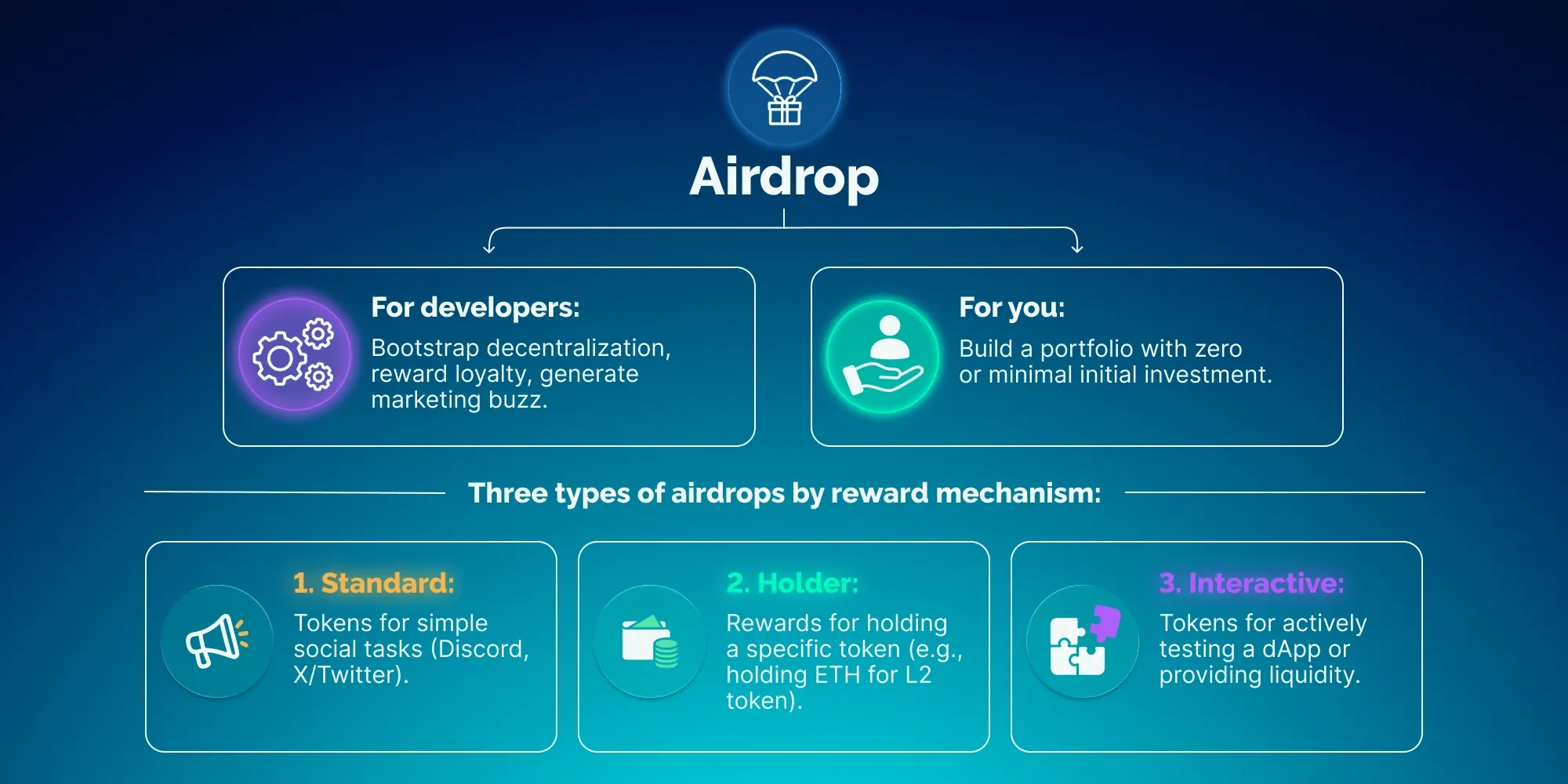
An airdrop is a distribution of free tokens to the wallets of community members. For developers, it’s a way to bootstrap decentralization, reward loyalty, and generate marketing buzz. For you, it’s an opportunity to build a portfolio with zero or minimal initial investment.
There are three types of airdrops by reward mechanism:
- Standard airdrops: tokens distributed for simple social tasks (joining Discord, following X/Twitter);
- Holder airdrops: rewards for simply holding a specific token (e.g., holding ETH to receive an L2 token);
- Interactive airdrops: tokens given to those who actively test a dApp or provide liquidity.
What is a retrodrop?
A retrodrop (retroactive airdrop) is a reward given to users who interacted with a protocol before it had a token. Unlike standard airdrops, retrodrops are not announced in advance. The project takes a snapshot of the blockchain at a specific moment and distributes tokens to wallets that meet the criteria.
Why retrodrops are superior:
- Higher value: because they reward real usage (liquidity, volume), token allocations are often worth thousands of dollars;
- No gatekeeping: you don’t need to be an influencer; you just need to be an active user of the ecosystem.
Notable retrodrop examples: Arbitrum (March 2023, ~$2,000+ per eligible wallet), Optimism (multi-round retrodrop), Starknet, LayerZero, Celestia, Jito (Solana). Upcoming retrodrop candidates in 2026 include ecosystems on Base, Monad, and modular L2s.
Classification of airdrops and retrodrops
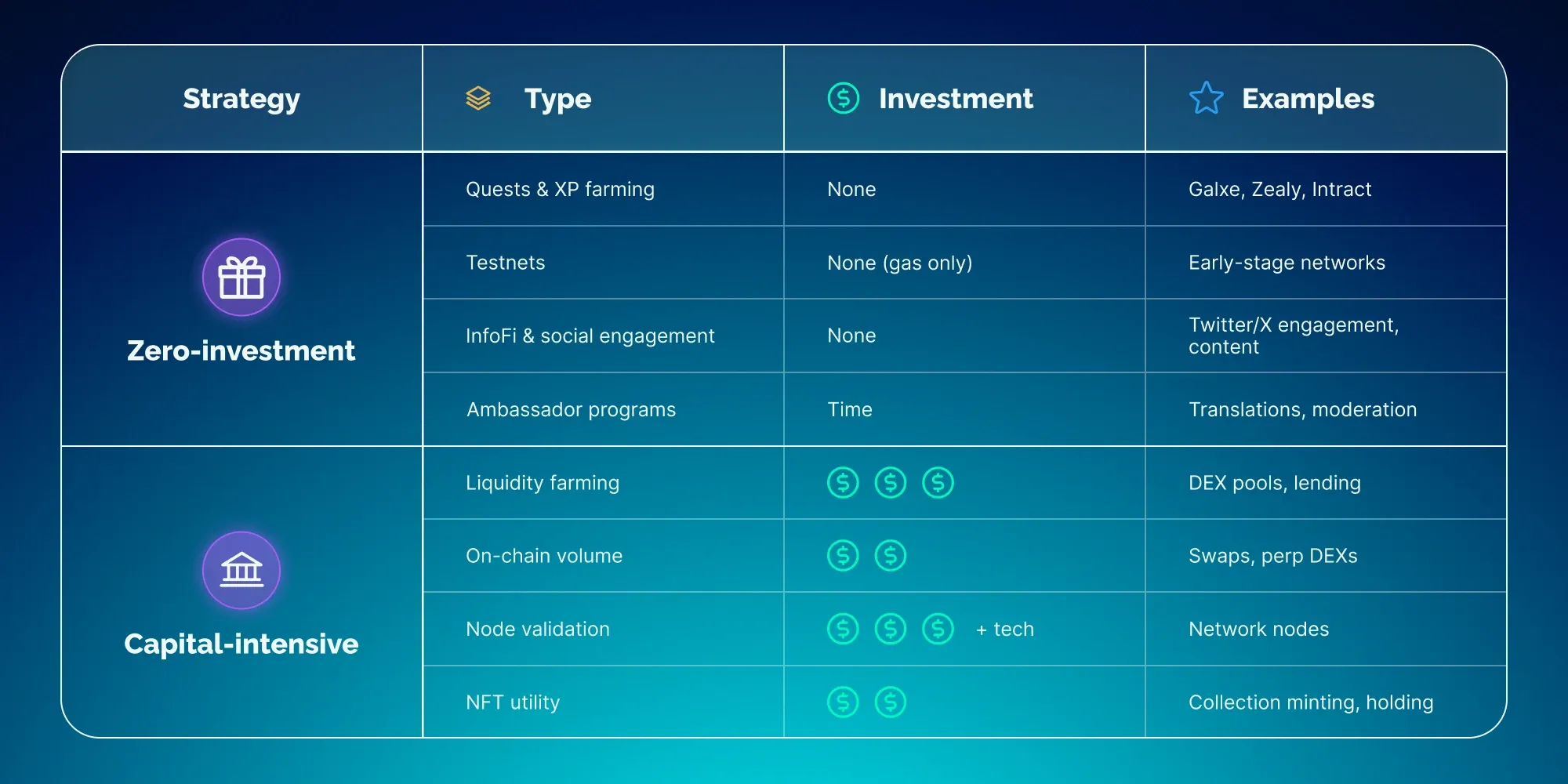
Strategically, airdrops and retrodrops fall into two paths based on required investment:
How projects choose winners
Projects are moving away from simple clicks toward value-based metrics. To qualify for the biggest drops, your on-chain activity should look like a genuine power user.
Key metrics to focus on:
- Transaction volume: moving $1,000+ through the protocol;
- Liquidity provision (LP): staking assets in pools or lending protocols;
- Consistency: transacting once a week for 3–6 months is better than 100 transactions in one day;
- Diversity: interacting with multiple dApps within the same ecosystem (e.g., bridge → DEX → NFT marketplace).
How to find gem projects without wasting time
In airdrop hunting, efficiency is key. You need to distinguish between a project with potential and a dead-end quest. Here are the top tools for discovery:
- Cryptorank (Drop Hunting): monitor investment rounds and active retrodrops;
- DefiLlama: track TVL (Total Value Locked) growth to find trending protocols;
- TweetScout: analyze the quality of a project’s Twitter following and which VCs are interested;
- Website & documentation: audit the site and docs. The site shouldn’t look rushed, and the documentation must be consistent (pro tip: use ChatGPT to spot contradictions or technical errors);
- Discord presence: evaluate the community vibe. Is it truly active? Monitor how moderators interact with users;
- Funding & backers: look for at least $3M from reputable VCs (Tier-1 / Tier-2 funds), not no-name players;
- Team transparency: the team should ideally be doxxed (not anonymous) with verifiable professional backgrounds.
Best time to farm: the bear market. Projects typically launch (TGE) when the market turns green to maximize valuation. If you start during peak euphoria, you risk spending capital on projects that may never launch or will be diluted by the masses.
3-point gem checklist:
- Funding: at least $3M from Tier-1/Tier-2 VCs.
- Product maturity: is there a working product or just a landing page?
- Community health: active Discord with real users, or just bots farming “GM”?
Your essential toolkit for airdrop hunting
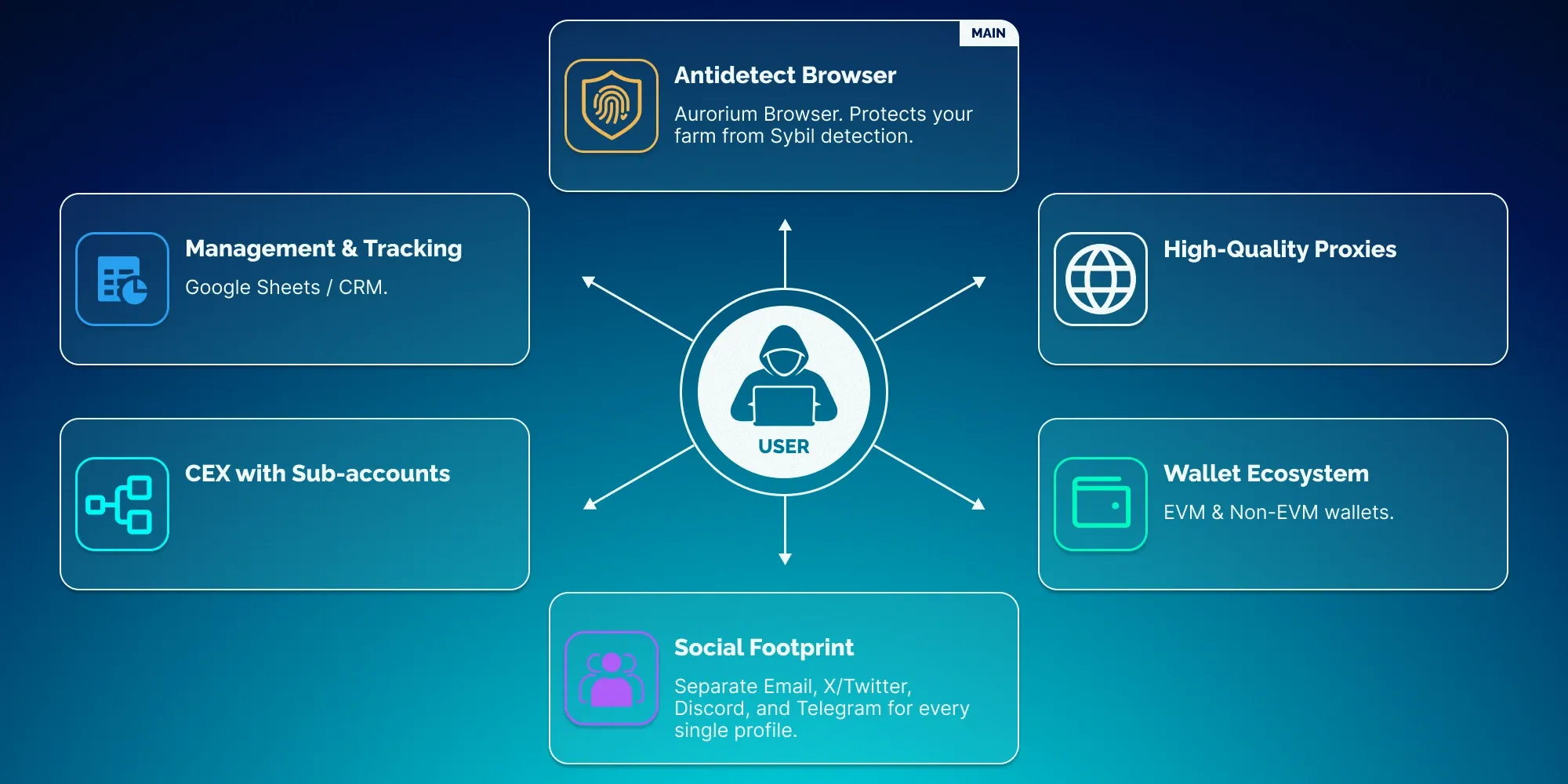
To operate professionally and minimize the risk of being banned, you need a robust infrastructure:
- Antidetect browser: your core tool. Aurorium ensures that each of your accounts operates in a completely isolated digital environment. By spoofing fingerprints at the kernel level and using AI-driven generation, it makes each profile look like a unique, legitimate user, protecting your farm from Sybil detection;
- High-quality proxies: never use free or low-grade proxies. Residential or mobile proxies are mandatory to provide your profiles with clean, trusted IP addresses;
- Wallet ecosystem:
- Rabby or Zerion: the most user-friendly wallets for tracking assets across EVM chains;
- Network-specific wallets: you’ll also need wallets for non-EVM ecosystems like Solana, Sui, or Cosmos.
- Social footprint: a dedicated set of unique accounts (Email, X/Twitter, Discord, Telegram) for every profile in your browser;
- Exchange with sub-accounts (e.g., OKX): use sub-accounts to fund and withdraw from your wallets. Crucial rule: 1 wallet = 1 specific sub-account. Never cross-contaminate funds between your farm wallets, or they will be linked on-chain;
- Management & tracking: use Google Sheets or specialized CRM tools to log every action, transaction date, and expense. Tracking your “risk-reward” ratio is the only way to ensure long-term profitability.
Multi-accounting: how to scale your profit
If one account yields a $2,000 drop, 50 accounts yield $100,000. This is known as Sybil activity — creating multiple identities to maximize gains.
However, projects now use sophisticated anti-bot filters to find and disqualify Sybil accounts. If your accounts are linked by the same IP, the same browser fingerprint, or “serial” transaction patterns, you will get nothing. This process is sometimes called a “sybil-cut” — disqualification of suspected multi-accounters at the snapshot stage.
How to use Aurorium for crypto multi-accounting
To successfully scale your retrodrops, you must ensure every account looks like a unique, independent human. This is where Aurorium becomes your primary weapon.
- Isolation: every browser profile in Aurorium has its own cookies, cache, and local storage. Projects cannot see that “Wallet A” and “Wallet B” are managed from the same computer;
- Fingerprint management: Aurorium spoofs hardware IDs, Canvas, and WebGL parameters. Each profile appears as a different device (e.g., one looks like a MacBook in London, another like a Windows PC in Singapore);
- Proxy integration: by assigning a unique residential proxy to each profile, you ensure that every wallet has a unique, high-trust IP address.
A step-by-step strategy for 2026
If you want to start earning today, follow this professional workflow:
Step 1: Research the ecosystems
Focus on Tier 1 projects that have raised significant venture capital but haven’t launched a token yet. Look for projects with $50M+ in funding. Current ecosystems worth watching: Monad, MegaETH, Berachain, modular L2s on Base, Solana DeFi protocols.
Step 2: Set up your infrastructure
Open Aurorium and create 10–50 profiles. Assign a dedicated crypto wallet (Metamask, Rabby) and a unique residential proxy to each.
Step 3: Social warm-up
Most airdrops check for “real” social media activity. Connect each profile to a unique X/Twitter and Discord account. Make them look alive — post, follow, and engage.
Step 4: The on-chain “dance”
Begin interacting with your target protocol. Bridge some ETH to the network, swap tokens on a DEX once a week, and perhaps mint a free NFT.
Pro tip: avoid “dust” transactions. Sending $1 back and forth looks like a bot. Aim for at least $10–$50 per transaction to stay under the radar.
Step 5: Maintain the paper trail
Use the built-in CRM in Aurorium to track which accounts have interacted with which protocols. This prevents you from forgetting accounts or repeating patterns that might look suspicious.
Risks and how to avoid them
Airdrop hunting is a high-risk, high-reward niche. To stay profitable, you must navigate these primary threats:
- Security & scams: the ecosystem is riddled with phishing links and fake testnets. Always verify URLs, never share your seed phrase, and avoid downloading unverified files to your primary workstation;
- Protocol risks: if you provide liquidity, you face the risk of smart contract exploits or “rug pulls” where the project founders disappear with the funds;
- Sybil filtering (the “not eligible” screen): projects increasingly use sophisticated algorithms to detect multi-accounters (e.g., Trusta AI for Monad, LayerZero’s sybil detection). If your accounts are linked or show bot-like behavior, you will be disqualified;
- Opportunity cost: you might lock up your capital and time for 12–18 months only to receive a drop that doesn’t even cover your gas fees.
FAQ
Are crypto airdrops free money?
Technically yes — you don’t pay for the tokens themselves. But you spend gas fees, capital (for liquidity strategies), and time on each protocol you farm. A successful retrodrop hunt can yield thousands of dollars per wallet, but a failed campaign can cost more in gas than you earn.
How long does it take to qualify for a retrodrop?
Most major retrodrops require 3–12 months of consistent activity before the snapshot. Some ecosystems (LayerZero, Starknet) had farming windows of 18+ months. Plan for the long game.
What is a Sybil attack in airdrop hunting?
A Sybil attack is creating multiple identities (wallets, accounts) to claim the same airdrop multiple times. Projects detect Sybils through on-chain pattern analysis, IP/fingerprint clustering, and funding source tracing. Tools like Aurorium prevent the technical fingerprint side of Sybil detection.
Are airdrops taxable?
In most jurisdictions, airdrops are taxed as ordinary income at the moment of receipt, based on the token’s fair market value at that time. Selling later may trigger an additional capital gains tax. Consult a local crypto-savvy tax advisor.
Can you make a living from airdrop hunting?
Yes — there’s a category of full-time “airdrop hunters” who earn six-figure annual income. But this requires significant upfront capital ($5K–$50K), professional infrastructure (antidetect browser, residential proxies, sub-accounts), and consistent execution over 6–18 months per ecosystem.
What’s the difference between an airdrop and a retrodrop?
A standard airdrop is announced in advance and rewards basic actions (joining Discord, holding a token). A retrodrop is retroactive — the project takes a snapshot of past on-chain activity without warning and rewards real users. Retrodrops typically pay much more because they target genuine usage.
Conclusion
Making money with crypto airdrops and retrodrops in 2026 is about managing a professional fleet of digital identities. By using Aurorium, you can turn airdrop hunting from a hobby into a high-revenue business.